Elijah Baker Elijah Baker
0 Course Enrolled • 0 Course CompletedBiography
Latest updated Professional-Machine-Learning-Engineer Trustworthy Pdf - How to Download for Exam Professional-Machine-Learning-Engineer Dumps free
As you know, the Professional-Machine-Learning-Engineer certificate is hard to get for most people. But our Professional-Machine-Learning-Engineer study guide will offer you the most professional guidance. As old saying goes, opportunities are always for those who prepare themselves well. In the end, you will easily pass the Professional-Machine-Learning-Engineer Exam through our assistance. Then you will find that your work ability is elevated greatly by studying our Professional-Machine-Learning-Engineer actual exam. In the end, you will become an excellent talent.
The Google Professional Machine Learning Engineer certification exam covers a wide range of topics related to machine learning engineering, including data preparation and analysis, feature engineering, model selection and training, hyperparameter tuning, deployment, and monitoring. Candidates will be required to demonstrate their ability to develop and manage machine learning models using Google Cloud Platform tools and services. Successful candidates will be able to design, implement, and optimize machine learning models to solve complex business problems and improve operational efficiency. The Google Professional Machine Learning Engineer Certification Exam is an excellent way for individuals to demonstrate their expertise in the field of machine learning engineering and to advance their careers in this rapidly growing field.
>> Professional-Machine-Learning-Engineer Trustworthy Pdf <<
Exam Professional-Machine-Learning-Engineer Dumps | Reliable Professional-Machine-Learning-Engineer Test Materials
PassTestking wants to win the trust of Google Professional Machine Learning Engineer (Professional-Machine-Learning-Engineer) exam candidates at any cost. To achieve this objective PassTestking is offering real, updated, and error-free Google Professional Machine Learning Engineer (Professional-Machine-Learning-Engineer) exam dumps in three different formats. These Google Professional Machine Learning Engineer (Professional-Machine-Learning-Engineer) exam questions formats are PassTestking Google Professional-Machine-Learning-Engineer dumps PDF files, desktop practice test software, and web-based practice test software.
Google Professional Machine Learning Engineer Certification Exam is recognized globally as a standard of excellence in the field of machine learning engineering. It is a valuable credential that can enhance the career prospects of individuals by demonstrating their expertise and proficiency in machine learning engineering to potential employers.
Google Professional Machine Learning Engineer Sample Questions (Q45-Q50):
NEW QUESTION # 45
You have trained a DNN regressor with TensorFlow to predict housing prices using a set of predictive features. Your default precision is tf.float64, and you use a standard TensorFlow estimator; estimator = tf.estimator.DNNRegressor( feature_columns=[YOUR_LIST_OF_FEATURES], hidden_units-[1024, 512, 256], dropout=None) Your model performs well, but Just before deploying it to production, you discover that your current serving latency is 10ms @ 90 percentile and you currently serve on CPUs. Your production requirements expect a model latency of 8ms @ 90 percentile. You are willing to accept a small decrease in performance in order to reach the latency requirement Therefore your plan is to improve latency while evaluating how much the model's prediction decreases. What should you first try to quickly lower the serving latency?
- A. Switch from CPU to GPU serving
- B. Increase the dropout rate to 0.8 and retrain your model.
- C. Increase the dropout rate to 0.8 in_PREDICT mode by adjusting the TensorFlow Serving parameters
- D. Apply quantization to your SavedModel by reducing the floating point precision to tf.float16.
Answer: D
Explanation:
* Quantization is a technique that reduces the numerical precision of the weights and activations of a neural network, which can improve the inference speed and reduce the memory footprint of the model1.
* Reducing the floating point precision from tf.float64 to tf.float16 can potentially halve the latency and memory usage of the model, while having minimal impact on the accuracy2.
* Increasing the dropout rate to 0.8 in either mode would not affect the latency, but would likely degrade the performance of the model significantly, as dropout is a regularization technique that randomly drops out units during training to prevent overfitting3.
* Switching from CPU to GPU serving may or may not improve the latency, depending on the hardware specifications and the model complexity, but it would also incur additional costs and complexity for deployment4
NEW QUESTION # 46
Your team is working on an NLP research project to predict political affiliation of authors based on articles they have written. You have a large training dataset that is structured like this: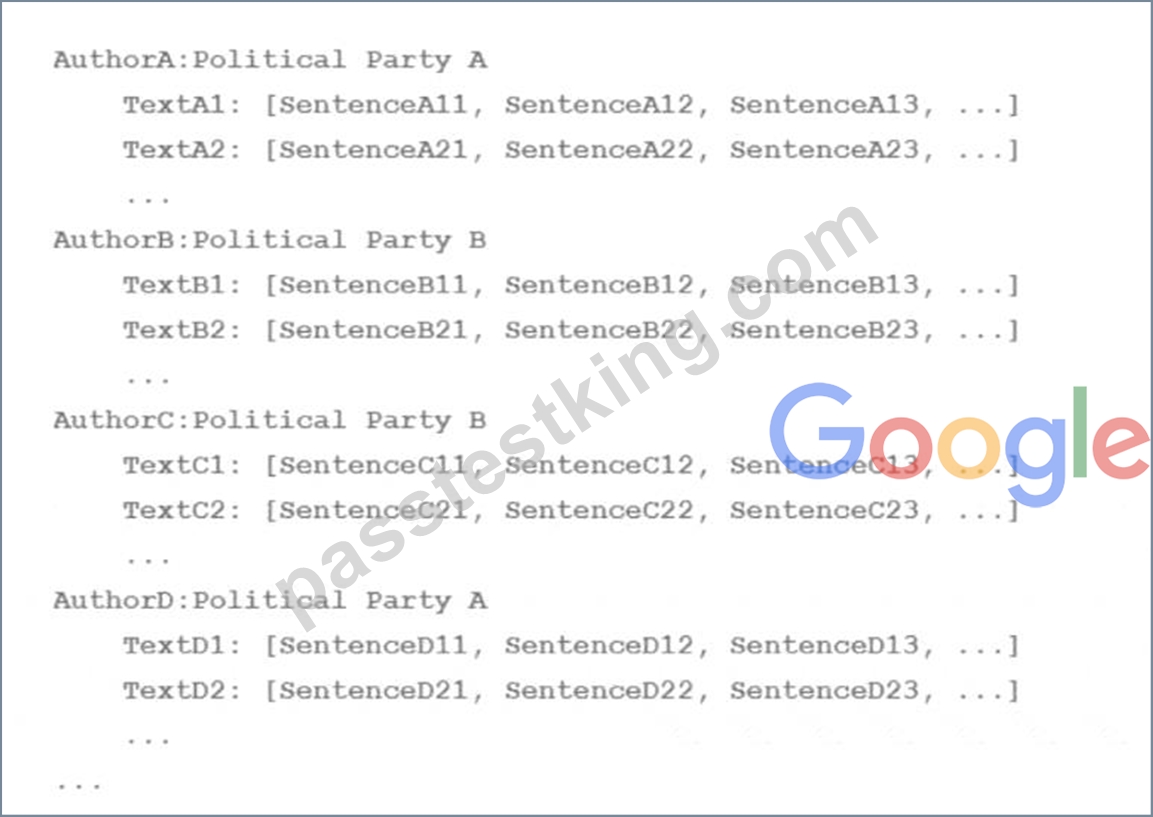
You followed the standard 80%-10%-10% data distribution across the training, testing, and evaluation subsets.
How should you distribute the training examples across the train-test-eval subsets while maintaining the
80-10-10 proportion?
- A.
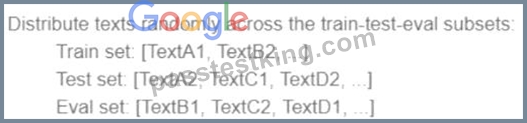
- B.

- C.

- D.

Answer: B
Explanation:
The best way to distribute the training examples across the train-test-eval subsets while maintaining the
80-10-10 proportion is to use option C. This option ensures that each subset contains a balanced and representative sample of the different classes (Democrat and Republican) and the different authors. This way, the model can learn from a diverse and comprehensive set of articles and avoid overfitting or underfitting.
Option C also avoids the problem of data leakage, which occurs when thesame author appears in more than one subset, potentially biasing the model and inflating its performance. Therefore, option C is the most suitable technique for this use case.
NEW QUESTION # 47
You work for an advertising company and want to understand the effectiveness of your company's latest advertising campaign. You have streamed 500 MB of campaign data into BigQuery. You want to query the table, and then manipulate the results of that query with a pandas dataframe in an Al Platform notebook. What should you do?
- A. Use Al Platform Notebooks' BigQuery cell magic to query the data, and ingest the results as a pandas dataframe
- B. Download your table from BigQuery as a local CSV file, and upload it to your Al Platform notebook instance Use pandas. read_csv to ingest the file as a pandas dataframe
- C. From a bash cell in your Al Platform notebook, use the bq extract command to export the table as a CSV file to Cloud Storage, and then use gsutii cp to copy the data into the notebook Use pandas. read_csv to ingest the file as a pandas dataframe
- D. Export your table as a CSV file from BigQuery to Google Drive, and use the Google Drive API to ingest the file into your notebook instance
Answer: A
Explanation:
AI Platform Notebooks is a service that provides managed Jupyter notebooks for data science and machine learning. You can use AI Platform Notebooks to create, run, and share your code and analysis in a collaborative and interactive environment1. BigQuery is a service that allows you to analyze large-scale and complex data using SQL queries. You can use BigQuery to stream, store, and query your data in a fast and cost-effective way2. Pandas is a popular Python library that provides data structures and tools for data analysis and manipulation. You can use pandas to create, manipulate, and visualize dataframes, which are tabular data structures with rows and columns3.
AI Platform Notebooks provides a cell magic, %%bigquery, that allows you to run SQL queries on BigQuery data and ingest the results as a pandas dataframe. A cell magic is a special command that applies to the whole cell in a Jupyter notebook. The %%bigquery cell magic can take various arguments, such as the name of the destination dataframe, the name of the destination table in BigQuery, the project ID, and the query parameters4. By using the %%bigquery cell magic, you can query the data in BigQuery with minimal code and manipulate the results with pandas in AI Platform Notebooks. This is the most convenient and efficient way to achieve your goal.
The other options are not as good as option A, because they involve more steps, more code, and more manual effort. Option B requires you to export your table as a CSV file from BigQuery to Google Drive, and then use the Google Drive API to ingest the file into your notebook instance. This option is cumbersome and time-consuming, as it involves moving the data across different services and formats. Option C requires you to download your table from BigQuery as a local CSV file, and then upload it to your AI Platform notebook instance. This option is also inefficient and impractical, as it involves downloading and uploading large files, which can take a long time and consume a lot of bandwidth. Option D requires you to use a bash cell in your AI Platform notebook to export thetable as a CSV file to Cloud Storage, and then copy the data into the notebook. This option is also complex and unnecessary, as it involves using different commands and tools to move the data around. Therefore, option A is the best option for this use case.
References:
* AI Platform Notebooks documentation
* BigQuery documentation
* pandas documentation
* Using Jupyter magics to query BigQuery data
NEW QUESTION # 48
You are deploying a new version of a model to a production Vertex Al endpoint that is serving traffic You plan to direct all user traffic to the new model You need to deploy the model with minimal disruption to your application What should you do?
- A. 1 Create a new model Set the parentModel parameter to the model ID of the currently deployed model Upload the model to Vertex Al Model Registry.
2 Deploy the new model to the existing endpoint and set the new model to 100% of the traffic. - B. 1. Create a new endpoint.
2. Create a new model Set the parentModel parameter to the model ID of the currently deployed model and set it as the default version Upload the model to Vertex Al Model Registry
3. Deploy the new model to the new endpoint and set the new model to 100% of the traffic - C. 1, Create a new model Set it as the default version Upload the model to Vertex Al Model Registry
2 Deploy the new model to the existing endpoint - D. 1 Create a new endpoint.
2 Create a new model Set it as the default version Upload the model to Vertex Al Model Registry.
3. Deploy the new model to the new endpoint.
4 Update Cloud DNS to point to the new endpoint
Answer: A
Explanation:
The best option for deploying a new version of a model to a production Vertex AI endpoint that is serving traffic, directing all user traffic to the new model, and deploying the model with minimal disruption to your application, is to create a new model, set the parentModel parameter to the model ID of the currently deployed model, upload the model to Vertex AI Model Registry, deploy the new model to the existing endpoint, and set the new model to 100% of the traffic. This option allows you to leverage the power and simplicity of Vertex AI to update your model version and serve online predictions with low latency. Vertex AI is a unified platform for building and deploying machine learning solutions on Google Cloud. Vertex AI can deploy a trained model to an online prediction endpoint, which can provide low-latency predictions for individual instances. A model is a resource that represents a machine learning model that you can use for prediction. A model can have one or more versions, which are different implementations of the same model. A model version can have different parameters, code, or data than another version of the same model. A model version can help you experiment and iterate on your model, and improve the model performance and accuracy. A parentModel parameter is a parameter that specifies the model ID of the model that the new model version is based on. A parentModel parameter can help you inherit the settings and metadata of the existing model, and avoid duplicating the model configuration. Vertex AI Model Registry is a service that can store and manage your machine learning models on Google Cloud. Vertex AI Model Registry can help you upload and organize your models, and track the model versions and metadata. An endpoint is a resource that provides the service endpoint (URL) you use to request the prediction. An endpoint can have one or more deployed models, which are instances of model versions that are associated with physical resources. A deployed model can help you serve online predictions with low latency, and scale up or down based on the traffic. By creating a new model, setting the parentModel parameter to the model ID of the currently deployed model, uploading the model to Vertex AI Model Registry, deploying the new model to the existing endpoint, and setting the new model to
100% of the traffic, you can deploy a new version of a model to a production Vertex AI endpoint that is serving traffic, direct all user traffic to the new model, and deploy the model with minimal disruption to your application1.
The other options are not as good as option C, for the following reasons:
* Option A: Creating a new endpoint, creating a new model, setting it as the default version, uploading the model to Vertex AI Model Registry, deploying the new model to the new endpoint, and updating Cloud DNS to point to the new endpoint would require more skills and steps than creating a new model, setting the parentModel parameter to the model ID of the currently deployed model, uploading the model to Vertex AI Model Registry, deploying the new model to the existing endpoint, and setting the new model to 100% of the traffic. Cloud DNS is a service that can provide reliable and scalable Domain Name System (DNS) services on Google Cloud. Cloud DNS can help you manage your DNS records, and resolve domain names to IP addresses. By updating Cloud DNS to point to the new endpoint, you can redirect the user traffic to the new endpoint, and avoid breaking the existing application. However, creating a new endpoint, creating a new model, setting it as the default version, uploading the model to Vertex AI Model Registry, deploying the new model to the new endpoint, and updating Cloud DNS to point to the new endpoint would require more skills and steps than creating a new model, setting the parentModel parameter to the model ID of the currently deployed model, uploading the model to Vertex AI Model Registry, deploying the new model to the existing endpoint, and setting the new model to 100% of the traffic. You would need to write code, create and configure the new endpoint, create and configure the new model, upload the model to Vertex AI Model Registry, deploy the model to the new endpoint, and update Cloud DNS to point to the new endpoint. Moreover, this option would create a new endpoint, which can increase the maintenance and management costs2.
* Option B: Creating a new endpoint, creating a new model, setting the parentModel parameter to the model ID of the currently deployed model and setting it as the default version, uploading the model to Vertex AI Model Registry, and deploying the new model to the new endpoint and setting the new model to 100% of the traffic would require more skills and steps than creating a new model, setting the parentModel parameter to the model ID of the currently deployed model, uploading the model to Vertex AI Model Registry, deploying the new model to the existing endpoint, and setting the new model to
100% of the traffic. A parentModel parameter is a parameter that specifies the model ID of the model that the new model version is based on. A parentModel parameter can help you inherit the settings and metadata of the existing model, and avoid duplicating the model configuration. A default version is a model version that is used for prediction when no other version is specified. A default version can help you simplify the prediction request, and avoid specifying the model version every time. By setting the parentModel parameter to the model ID of the currently deployed model and setting it as the default version, you can create a new model that is based on the existing model, and use it for prediction without specifying the model version. However, creating a new endpoint, creating a new model, setting the parentModel parameter to the model ID of the currently deployed model and setting it as the default version, uploading the model to Vertex AI Model Registry, and deploying the new model to the new endpoint and setting the new model to 100% of the traffic would require more skills and steps than creating a new model, setting the parentModel parameter to the model ID of the currently deployed model, uploading the model to Vertex AI Model Registry, deploying the new model to the existing endpoint, and setting the new model to 100% of the traffic. You would need to write code, create and configure the new endpoint, create and configure the new model, upload the model to Vertex AI Model Registry, and deploy the model to the new endpoint. Moreover, this option would create a new endpoint, which can increase the maintenance and management costs2.
* Option D: Creating a new model, setting it as the default version, uploading the model to Vertex AI Model Registry, and deploying the new model to the existing endpoint would not allow you to inherit the settings and metadata of the existing model, and could cause errors or poor performance. A default version is a model version that is used for prediction when no other version is specified. A default version can help you simplify the prediction request, and avoid specifying the model version every time. By setting the new model as the default version, you can use the new model for prediction without specifying the model version. However, creating a new model, setting it as the default version, uploading the model to Vertex AI Model Registry, and deploying the new model to the existing endpoint would not allow you to inherit the settings and metadata of the existing model, and could cause errors or poor performance. You would need to write code, create and configure the new model, upload the model to Vertex AI Model Registry, and deploy the model to the existing endpoint. Moreover, this option would not set the parentModel parameter to the model ID of the currently deployed model, which could prevent you from inheriting the settings and metadata of the existing model, and cause inconsistencies or conflicts between the model versions2.
References:
* Preparing for Google Cloud Certification: Machine Learning Engineer, Course 3: Production ML Systems, Week 2: Serving ML Predictions
* Google Cloud Professional Machine Learning Engineer Exam Guide, Section 3: Scaling ML models in production, 3.1 Deploying ML models to production
* Official Google Cloud Certified Professional Machine Learning Engineer Study Guide, Chapter 6:
Production ML Systems, Section 6.2: Serving ML Predictions
* Vertex AI
* Cloud DNS
NEW QUESTION # 49
You work for a company that provides an anti-spam service that flags and hides spam posts on social media platforms. Your company currently uses a list of 200,000 keywords to identify suspected spam posts. If a post contains more than a few of these keywords, the post is identified as spam. You want to start using machine learning to flag spam posts for human review. What is the main advantage of implementing machine learning for this business case?
- A. A much longer keyword list can be used to flag spam posts.
- B. Posts can be compared to the keyword list much more quickly.
- C. New problematic phrases can be identified in spam posts.
- D. Spam posts can be flagged using far fewer keywords.
Answer: C
Explanation:
The main advantage of implementing machine learning for this business case is that new problematic phrases can be identified in spam posts. This is because machine learning can learn from the data and the feedback, and adapt to the changing patterns and trends of spam posts. Machine learning can also capture the semantic and contextual meaning of the posts, and not just rely on the presence or absence of keywords. By using machine learning, you can improve the accuracy and coverage of your anti-spam service, and detect new and emerging types of spam posts that may not be captured by the keyword list.
The other options are not advantages of implementing machine learning for this business case for the following reasons:
* A. Posts can be compared to the keyword list much more quickly is not an advantage, as it does not improve the quality or effectiveness of the anti-spam service. It only improves the efficiency of the service, which is not the primary objective. Moreover, machine learning may not necessarily be faster than the keyword list, depending on the complexity and size of the model and the data.
* C. A much longer keyword list can be used to flag spam posts is not an advantage, as it does not address the limitations or challenges of the keyword list approach. It only increases the size and complexity of the keyword list, which can make it harder to maintain and update. Moreover, a longer keyword list may not improve the accuracy or coverage of the anti-spam service, as it may introduce more false positives or false negatives, or miss new and emerging types of spam posts.
* D. Spam posts can be flagged using far fewer keywords is not an advantage, as it does not reflect the capabilities or benefits of machine learning. It only reduces the size and complexity of the keyword list,
* which can make it easier to maintain and update. However, using fewer keywords may not improve the accuracy or coverage of the anti-spam service, as it may lose some information or meaning of the posts, or miss some types of spam posts.
References:
* Professional ML Engineer Exam Guide
* Preparing for Google Cloud Certification: Machine Learning Engineer Professional Certificate
* Google Cloud launches machine learning engineer certification
* Machine Learning for Spam Detection
* Spam Detection Using Machine Learning
NEW QUESTION # 50
......
Exam Professional-Machine-Learning-Engineer Dumps: https://www.passtestking.com/Google/Professional-Machine-Learning-Engineer-practice-exam-dumps.html
- Professional-Machine-Learning-Engineer Dump with the Help of www.pass4leader.com Exam Questions 💅 Open website ➠ www.pass4leader.com 🠰 and search for “ Professional-Machine-Learning-Engineer ” for free download 🔜Professional-Machine-Learning-Engineer Pdf Demo Download
- Professional-Machine-Learning-Engineer Exam Torrent - Professional-Machine-Learning-Engineer Practice Test - Professional-Machine-Learning-Engineer Quiz Torrent 🕒 Open website ✔ www.pdfvce.com ️✔️ and search for “ Professional-Machine-Learning-Engineer ” for free download 🌠Exam Professional-Machine-Learning-Engineer Format
- Professional-Machine-Learning-Engineer Exam Torrent - Professional-Machine-Learning-Engineer Practice Test - Professional-Machine-Learning-Engineer Quiz Torrent 😭 Download [ Professional-Machine-Learning-Engineer ] for free by simply entering ▶ www.prep4pass.com ◀ website 🐰Reliable Professional-Machine-Learning-Engineer Exam Camp
- Study Professional-Machine-Learning-Engineer Reference 🆖 Test Professional-Machine-Learning-Engineer Pattern 🪑 Exam Professional-Machine-Learning-Engineer Actual Tests 🤕 Search for ➥ Professional-Machine-Learning-Engineer 🡄 and download exam materials for free through ✔ www.pdfvce.com ️✔️ 💧Exam Professional-Machine-Learning-Engineer Format
- Pass Guaranteed Quiz 2025 Latest Google Professional-Machine-Learning-Engineer: Google Professional Machine Learning Engineer Trustworthy Pdf 🥧 Open ➥ www.prep4sures.top 🡄 and search for ⏩ Professional-Machine-Learning-Engineer ⏪ to download exam materials for free 🕉Professional-Machine-Learning-Engineer Latest Test Braindumps
- Professional-Machine-Learning-Engineer 100% Exam Coverage 🐁 Latest Professional-Machine-Learning-Engineer Exam Labs ➖ Reliable Professional-Machine-Learning-Engineer Exam Camp 🌍 Easily obtain free download of ⇛ Professional-Machine-Learning-Engineer ⇚ by searching on 「 www.pdfvce.com 」 🌼Test Professional-Machine-Learning-Engineer Simulator Free
- 2025 Professional-Machine-Learning-Engineer Trustworthy Pdf : Google Professional Machine Learning Engineer Realistic Professional-Machine-Learning-Engineer 100% Pass 🐧 Enter ➤ www.examdiscuss.com ⮘ and search for ▛ Professional-Machine-Learning-Engineer ▟ to download for free 👨Professional-Machine-Learning-Engineer 100% Exam Coverage
- New Professional-Machine-Learning-Engineer Trustworthy Pdf Free PDF | High Pass-Rate Exam Professional-Machine-Learning-Engineer Dumps: Google Professional Machine Learning Engineer 🐇 Simply search for ( Professional-Machine-Learning-Engineer ) for free download on “ www.pdfvce.com ” 🚁Professional-Machine-Learning-Engineer 100% Exam Coverage
- Web-Based Google Professional-Machine-Learning-Engineer Practice Exam Software 😼 Open “ www.testsimulate.com ” and search for [ Professional-Machine-Learning-Engineer ] to download exam materials for free 👗Professional-Machine-Learning-Engineer Hot Questions
- 100% Pass Rate Professional-Machine-Learning-Engineer Trustworthy Pdf - 100% Pass Professional-Machine-Learning-Engineer Exam 👆 Download ✔ Professional-Machine-Learning-Engineer ️✔️ for free by simply searching on ▛ www.pdfvce.com ▟ 😦Reliable Professional-Machine-Learning-Engineer Exam Camp
- Professional-Machine-Learning-Engineer Hot Questions 🦢 Latest Professional-Machine-Learning-Engineer Exam Labs 😮 Test Professional-Machine-Learning-Engineer Pattern 🧙 Search for { Professional-Machine-Learning-Engineer } and download exam materials for free through ▷ www.actual4labs.com ◁ 🏝Exam Professional-Machine-Learning-Engineer Format
- Professional-Machine-Learning-Engineer Exam Questions
- korodhsoaqoon.com peakperformance-lms.ivirtualhub.com daystar.oriontechnologies.com.ng formazionebusinessschool.sch.ng sohojitbd.com pedforsupplychain.my.id skillcloudacademy.com uniofai.com edumente.me club.campaignsuite.cloud